Our Story: How Baby Sign Language Became Our Family’s Common Ground
For the first two years of my firstborn’s life, the hospital sent me weekly emails with information and advice. In one of these emails, which arrived around the six-month mark, they sang the praises of using signs with babies. Although the article was about monolingual children, we ended up successfully using sign language with all three of our multilingual children. In this article, I’ll share how we used signs across three languages and why signing ended up being more useful than we ever expected.
Getting Started: Which Signs, and Which System?
The usual recommendation is to start with 3-5 signs, some related to basic needs (e.g. milk, water, food) and another 3-5 related to things that are fun and interesting to the baby (e.g. book, dog, music). As children grow and start signing, you can introduce new signs. For example, you can get more specific with foods (apple, pear, blueberry), or teach mom, dad, grandpa, grandma, or anything else of interest to the child and family. At the peak of our use, we had about 25-30 signs.
As you may know, sign language isn’t universal: there’s Italian Sign Language, American Sign Language (different from British Sign Language), French Sign Language, and so on.
We asked ourselves: what should we do, introduce three sign systems on top of the three languages we already speak (US English, Italian and Cantonese)? That didn’t seem practical. So we decided to use signs from ASL, American Sign Language, which are well known to everyone in the US who works in early childhood, including our babysitter at the time.
In practice, we used ASL signs, but during our interactions I would name the action or object in Italian, my husband in Cantonese, the babysitter in English. That way, with a single set of signs, the baby could express himself regardless of which language the adult spoke with him.
One Important Clarification
One clarification: in the United States, people often talk about “baby sign language,” which is not an accurate term. In baby signing, an adaptation of sign language has happened, such that the signs are used individually to indicate objects or actions, in a rudimentary way. It does not involve sentences or other morphological or syntactic structures.
In Baby Signing: What It Is–AndWhat It’s Not, Brenda Chafin Seal writes that:
Referring to the use of Baby Signing as a language is culturally inappropriate. Without ASL syntax, morphology, and pragmatics, ASL signs are simply signs or symbolic gestures. Similarly, using a few Spanish words with a baby in an English-speaking home may add Spanish vocabulary but does not imply Spanish language acquisition.

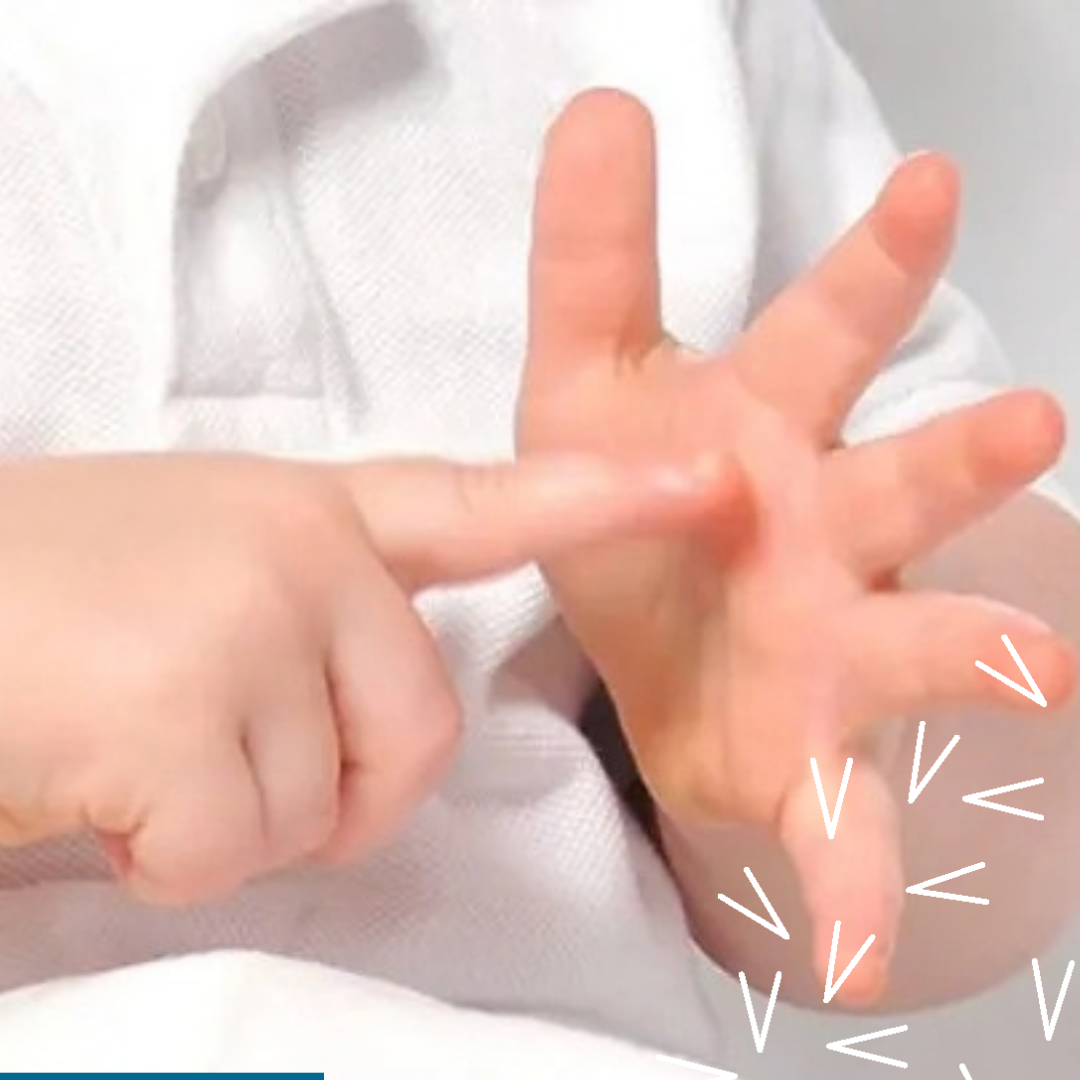
It is also important to be mindful of children’s motor skills: just as their first verbal words will be “dada,” “mama,” or similar, their first signs will be their own personal version of a given sign. For example, the ASL sign for water is the letter
W (the three middle fingers raised while the thumb and pinky touch) tapped against the chin a couple of times. My daughter, at six months old, communicated her need to drink by bringing her index finger to her mouth or the tip of her nose.
Benefits of Baby Signing
Since I have nothing to compare it to, I can’t say for certain whether using signs reduces tantrums or frustration. In our case, however, it probably did: it was very moving for us to be able to understand what they were starting to communicate, and the children felt satisfaction too, from letting us know if they were full (with the “all done” sign) or wanted more (“more”), to expressing excitement over one of us coming home (with the sign for dad or mom), or the thrill of seeing a dog or cat on the street. Over time, they learned to let us know if they wanted to read a book, listen to music, dance, and so on.
It was also useful to have a sort of lingua franca, if I can call it that, understood by all the adults involved regardless of the language each of them spoke and understood. Even in cases of limited communication among us adults – for example, between me and my in-laws – the sign the children used was unambiguous and immediately understood by everyone.
Won’t Signing Slow Down Verbal Development?
The most common concern that comes with using baby signing is that it will delay verbal development. The official position of American pediatricians and speech-language pathologists is that signing does not cause a delay in verbal language development in hearing children; after all, it was the hospital that suggested it in the first place.
In the case of hearing children, and as I’ve seen with my own kids, as spoken words emerged, the sign gradually fell out of use. To this day, to underline or add emphasis to something we say, we often pair the spoken word with the sign.
We had periods of overlap lasting about a year and a half to two years, during which they used the gesture for some words and the spoken word for others. Around age two to two and a half, the use of signs faded out.
An Unexpected Help
Signs came back into our lives at certain moments of need; an unexpected help, I must say.
Both monolingual and multilingual families I know use signing to communicate in situations involving diagnosed conditions (selective mutism, verbal dyspraxia) as well as everyday situations (music groups, swimming lessons). In the United States, professionals working with young children use this form of communication on a daily basis. It’s well known that not every child feels comfortable communicating verbally with a new person and/or in a new setting: using signs often helps break the ice more quickly, without forcing anything. In my experience, it’s comforting for hearing children to find the same signs across different settings and to be able to use them without being the pressure of using their voices.

In my family, this happened when we moved back to the US after a year in Italy. We were there right in 2019–2020: my firstborn had started daycare and then had to stop, like everyone else, all of a sudden. Being pulled out of his routine overnight had been quite a shock for him, and not an easy one.
Starting school again in September, once we were back in the US, in a new setting and with a language he hadn’t actively used in a year, was an equally delicate moment. From September to December he didn’t say a word at school, not to the teacher or to his classmates, but fortunately the teacher didn’t make an issue of it. For the whole first term, they communicated with signs, until he decided to start whispering and then speaking normally.
At that point I felt grateful to have introduced signs in early childhood, to have given us a way of communicating that could support our family communication in addition to verbal language.
Useful for the Whole Family
Looking back, signing gave our family something I didn’t expect when I first hesitated over it: a shared language that outlasted the “baby” stage, ready to step in whenever verbal words alone weren’t enough.
If you’re raising multilingual children and need support putting a plan like this into practice, that’s exactly what I help families with through my multilingual family consultations. Feel free reach out and let’s talk about what could work for your family.